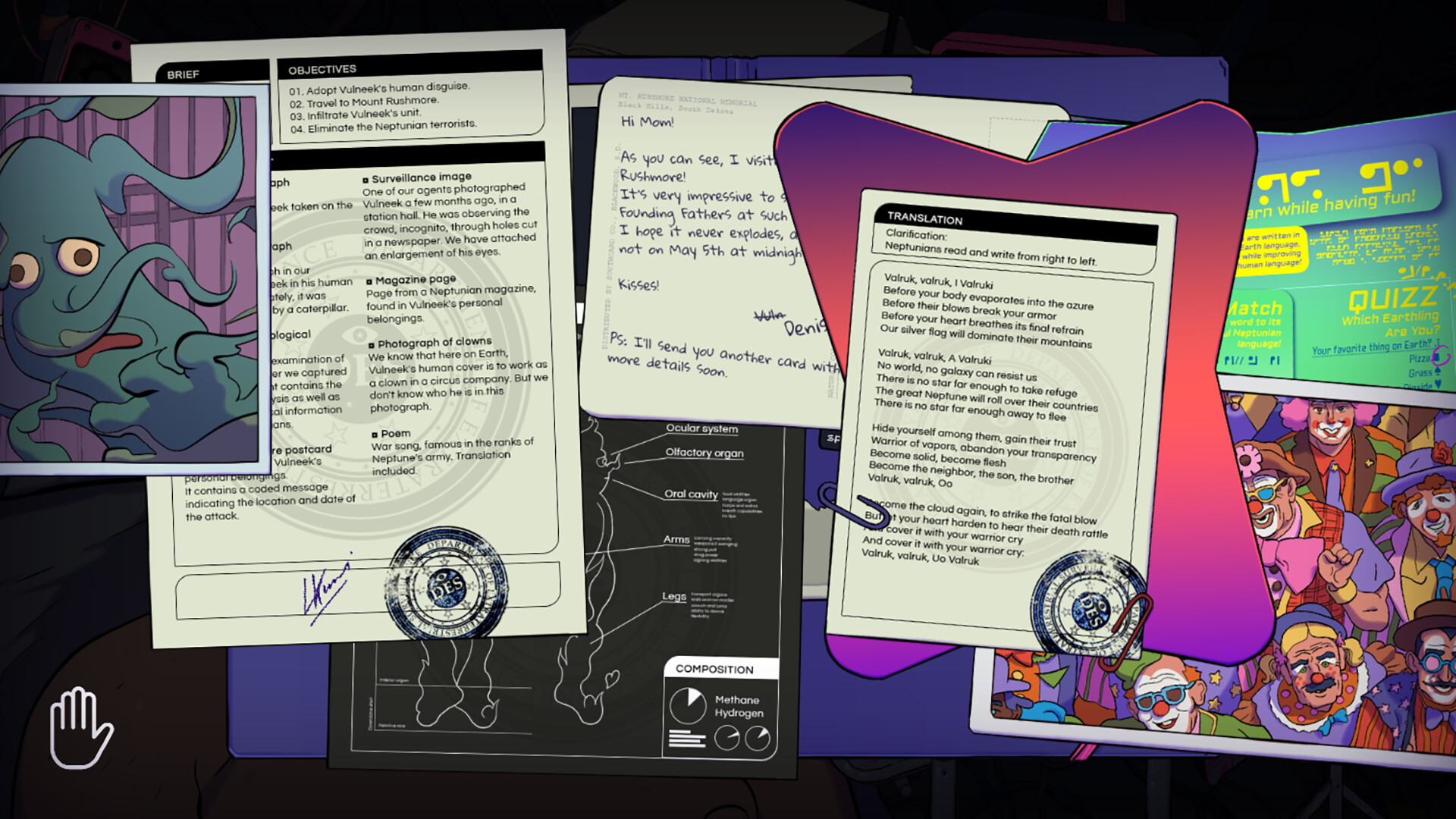
A Legion Was Here dossier guide has one job: get you into the conversation able to answer it. Every mission starts with a dossier, and reading it well decides whether you pass the conversation afterwards. The file is a pack of separate documents rather than one page, most of its clues are indirect, and some are planted to be wrong — so sort the evidence by how many documents agree with it, then copy the result onto Legion's left hand before you leave the briefing room.
On this page
The Legion Was Here Dossier Guide Method
Mission files mix several kinds of material:
- photographs, sometimes only a crop that shows part of the face;
- newspaper clippings and biographical notes;
- letters, including ones that mention eye or hair details;
- small everyday items, such as a chocolate-bar wrapper, that carry one decisive detail;
- occasionally a child's drawing of the target.
None of these is complete on its own. A dossier is written so that you have to combine two or three of them before a feature is certain.
Split The Documents Into Three Buckets
Sort every item as you read, rather than trying to memorise the file:
- Appearance cues — anything that narrows the face: hair, eye colour, nose shape and width, age, facial structure.
- Biographical cues — origin, profession, hobbies, favourite foods, family members, and the loved one Legion is impersonating.
- Noise that still matters — receipts, wrappers, a crayon shade, a colour of clothing. Dismiss the trivia on appearance grounds and it will still decide one multiple-choice answer.
Writing down which bucket each fact came from is what makes the interview answerable later, because the questions are drawn from the same file.
Weigh Clues By Agreement, Not By One Loud Image
Rank evidence by how directly it states the fact:
- A description in a document beats artwork. "Curly hair" in a clipping beats the hairstyle in a child's drawing.
- A real photograph beats a partial one, and both beat an illustration. A crop showing only the mouth, ear and chin is still a photograph.
- Agreement beats any single item. Three documents that agree outweigh one that contradicts them, and mismatched details are sometimes planted as bait rather than as mistakes.
The same rule applies to colour: when nothing states an eye colour directly, the shade of a crayon or an item of clothing is the signal you are meant to use — as a colour, not as a literal instruction to dye Legion's hair.
Every Document Is Double Sided, And The Back Often Holds The Answer
No document in the game is single-sided. The photograph, the clipping, the letter and the receipt all have a second face, and it is regularly the side that decides a question. The working rule is blunt: not everything on the back is relevant, but look anyway.
- Become Patrick. The photo shows only the bottom of his face; the back says "July in Greece", which is your Athens answer. The cowboy drawing's front is a cartoon and its back is Alan's birthday message — the source of both your age and the Wild West theme.
- London Undercover. The newspaper's front is the warehouse explosion that hospitalised Claude Roy; the back is an events calendar, and its entry for the Miranda Clinic closing for eight years is what turns a X-ray dated to him at 30 into an age of 38. The X-ray's own back names Julien DuPuit and lists his husband as Felipe DuPuit.
- Neptune's Guest. The Mount Rushmore postcard's front is the presidents in the usual order and its back is an encoded message, which is the entire point, because Neptunians read right to left.
- The Big Day. The classified ads' backs are all Jujuk park advertising, and the wedding invitation's front is the illustration while its back describes the event.
- Mafia Blues. The letter addressed to Michelino has Papa and Mattia on the back, which is how you learn the farm is still there and that one brother never left.
In every case, read the mission order first: it tells you which documents the client considers important, and most of the file is unreadable without that context.
The Dossier Answers, Mission By Mission
| Mission | The document that carries it | What it actually tells you |
|---|---|---|
Become Patrick | The back of the cowboy drawing | You are 36, so you turn 37, and your last party was the Wild West |
Become Patrick | The shopping list | You are vegan, and the blonde hair dye on it is your hair colour |
London Undercover | The back of the newspaper | The Miranda Clinic closed for eight years, which turns a X-ray dated to Claude at 30 into an age of 38 |
London Undercover | The back of the X-ray | Cover job bookseller; your husband is Felipe DuPuit; the nose job happened before the explosion |
Neptune's Guest | The back of the anatomy analysis | Their nose is a Roalnek, their reproductive organ an Xavorb, and fruit is fatal to them |
Neptune's Guest | The back of the Mount Rushmore postcard | Read it backwards — Neptunians read right to left, so Lincoln is the first head |
The Big Day | Helga's poem | You and Helga share a Lilik tattoo, and she names your eye shape, nose and eyebrows |
Mafia Blues | The napkin and the newspaper obituaries | Domiza never married and has just died, which is the answer she cannot give you directly |
Legion: Origins | The two poems and the cut-out overlay | Ten bolded words, ten numbers on the face diagram, and one document per number |
Turning Appearance Clues Into A Face
What comes out of the first bucket is a short list of slider decisions, not a face yet: hair style, eye colour, nose shape and width, an age range, and whatever facial structure the evidence supports. Carry the list to the operating room in that order and check each choice against the document it came from. The face creation guide covers the order of operations and how to avoid letting one loud clue override the rest.
Turning Biography Clues Into Answers
The second bucket exists for the interview. Cross-document chains are the point — a passport stub gives a city, a clipping gives a favourite food, a note from the target's partner gives a pet's name — and each link is a likely answer when the questioning starts.
Put these on your hand with their source attached, in short form: the fact, then the document it came from. An unstructured keyword is easy to misread under pressure, while a fact you can place ("favourite food — the interview in the May clipping") is not. The hand has limited space, so keep the citation only where two clues could otherwise be confused. How the interview draws on these facts covers what happens to the answers once you are in the room.
The worked examples above are transcribed from the player-made Legion Was Here guide on Steam, cross-checked against the Chinese puzzle-flow guide.